
Mayes Release Estimate Versus Actual
A projected release date is a working estimate for a sentence being administered. It is not the same as the actual date recorded after a person leaves custody. The Oklahoma Department of Corrections says its projected date can change and that the inmate receives a monthly statement of days remaining. Public disclosure of a particular date is restricted absent legitimate need. That means a family member, victim, or person involved in a court process should use authorized agency channels and should not treat an old projection as a promise.
A Mayes County jail booking poses a different question. A pretrial detainee has not yet received a sentence to compute. Release can depend on bond, a court order, dismissal, another hold, or later case action. Someone serving a county sentence may have a judgment and jail credit to examine, but the ODOC earned-credit worksheet does not calculate a county bond release. The jail and court record control that local inquiry.
Scheduled versus actual: An estimate answers when a sentence may end under current assumptions; a discharge or release record shows what actually occurred.
Even an actual Mayes jail exit does not prove return to the community. The sheriff's Released roster can mark a booking ended when the person transferred into ODOC or another agency's custody. Ask for the destination or manner of discharge when the next custody step matters.
Find Mayes County Release Dates
Begin by identifying who has custody. A person at the Mayes County Detention Center needs the sheriff and court route. A person sentenced into Oklahoma state custody needs the ODOC Offender Lookup and, where precision is authorized and needed, ODOC records. A person in federal custody needs the BOP locator instead. Crossing those systems without a matching record number can produce a confident answer about the wrong person.
- Confirm the person with the strongest available identifier: Mayes booking number for jail, court case number for the judgment, or ODOC number for state custody.
- Determine whether the person is pretrial, serving a county sentence, transferred to ODOC, on parole, or already discharged.
- For ODOC custody, accept the lookup disclaimer and inspect only the fields the real matched result displays. Do not promise that a future date will be public.
- For a Mayes sentence, obtain the judgment and ask the jail about credited time, current holds, and the existing booking-release record.
- Compare any projection with current court orders, sentence structure, statutory limits, credit status, and parole action.
- After release, prefer the actual jail release timestamp or ODOC discharge document over an earlier estimate.
The Mayes County released-inmate lookup provides the broader workflow for matching sheriff, court, state, and federal sources. Here, the narrow goal is to locate the controlling date and understand what can move it.
ODOC Mayes Release Date Search
ODOC Offender Lookup is relevant only when the person entered state correctional custody or supervision. It is not an archive of every short Mayes County booking. Search with an ODOC number when possible. Otherwise, match the state result to the Mayes court judgment and other lawful identifiers. The live application requires acceptance of a disclaimer and warns that abbreviated data may not fully explain the offense, sentence, or time to be served.
The captured ODOC search and lawful discharged-result state illustrates the official state route.
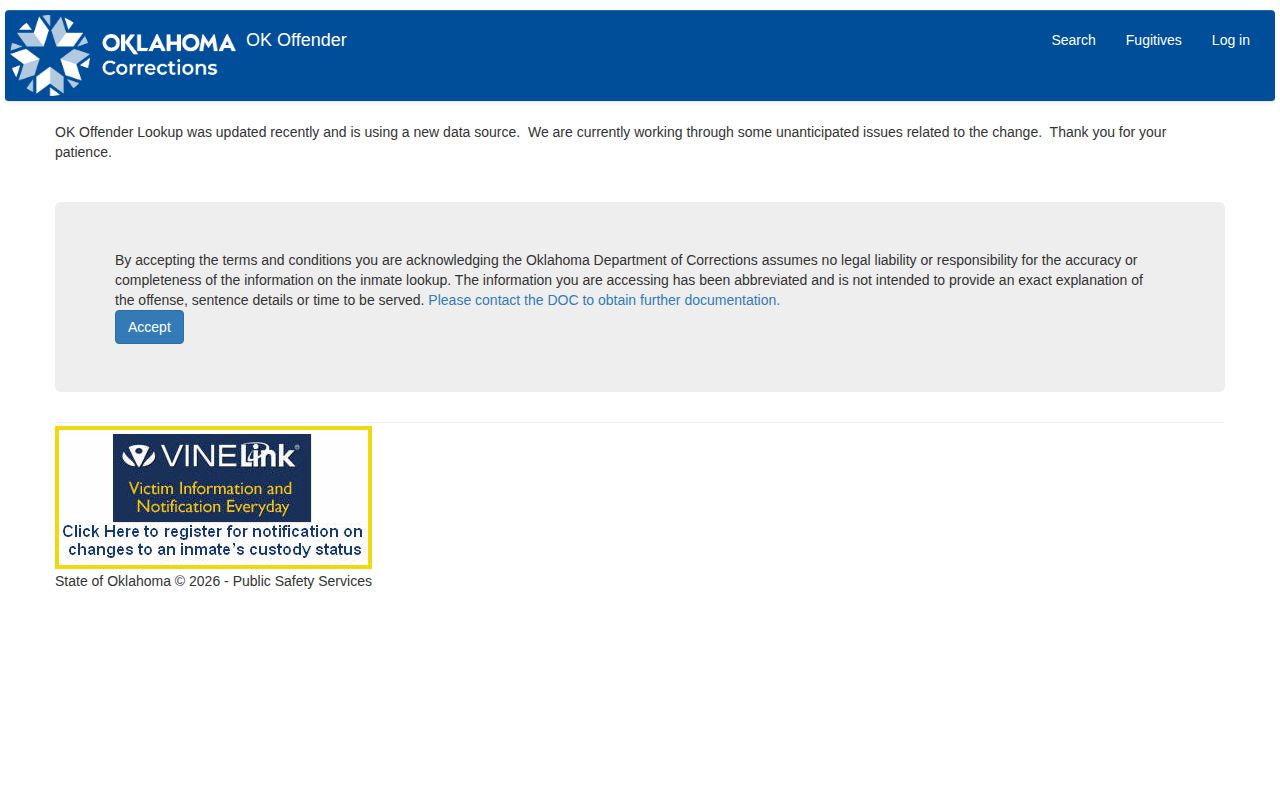
This screen supports use of the state system, but the fields visible on one result should not be promised for all people or all statuses.
| Source item | How to use it |
|---|---|
| ODOC number | Match the state record without relying on a common name. |
| Displayed status | Distinguish custody, supervision, or discharge as the live result reports it. |
| Offense and sentence data | Compare with the controlling judgment; abbreviated text is not the full court record. |
| Projected release date, if displayed | Treat it as tentative and subject to disclosure limits and later changes. |
| Actual discharge record | Use as stronger retrospective proof after the state term closes. |
ODOC's public-data description also includes fields such as name, sentence, reception date, and status. If Lookup is missing or appears anomalous, compare the public data, Mayes court record, and an ODOC records response. The state warned of possible issues tied to a data-source migration on the research date.
Note: A missing ODOC result does not establish release, since a jail-only case may never enter the state corrections system.
Oklahoma Credits Shape Mayes Dates
Oklahoma calls these earned credits. They reduce the time ODOC administers when the sentence and current law permit, but they do not rewrite the judgment imposed by the court. The governing statute is 57 O.S. §138. It uses earned-credit classes, while ODOC's current sentence-administration policy applies the statute to the individual record. An older chart or a simple days-per-month claim can be wrong for the offense date, class, sentence restriction, or later policy.
The ODOC projected-release worksheet models class levels 1 through 4, enhanced levels, and Ekstrand levels across several sample periods. It expressly excludes restricted-earned-credit sentences from those projections. That exclusion matters. A worksheet is a model, not a universal calculator, and it cannot safely supply an exact date without the controlling judgment, recognized jail or service credit, sentence structure, current credit level, achievement credits, and statutory limits.
- Earned credit
- A lawful reduction in administered time based on the applicable credit rules.
- Achievement credit
- Credit linked to qualifying accomplishments under the governing system.
- Concurrent sentences
- Terms served at the same time, subject to the judgment and administration rules.
- Consecutive sentences
- Terms ordered to run one after another.
- Discharge
- The closing of the controlling custody or supervision term, not merely leaving a prison on parole.
A county-sentenced time-served issue uses a different record set. Obtain the Mayes judgment, the jail register, and any court-recognized credit. Do not paste the ODOC class worksheet onto a bond case or assume that county staff use the same projection model.
Mayes Release Dates and 85 Percent
Oklahoma's 85-percent rule is offense-specific. Under 21 O.S. §13.1, a person convicted of an enumerated offense must serve at least 85 percent of the sentence of imprisonment. The person cannot be considered for parole before that threshold, and credits cannot reduce service below it. The statute's actual list and the version that applies on the offense date control.
Do not describe the rule as applying to every Oklahoma prisoner or every offense that sounds violent. It does not mean each covered person leaves at exactly the 85-percent point. Other sentence terms, holds, consecutive structure, and legal events may keep the person in custody longer. It sets a minimum service restriction for listed offenses.
Parole eligibility is also not a release date. The Oklahoma Pardon and Parole Board can place a case on a docket, issue a recommendation, or take an action within its authority, but ODOC custody records show whether release was later carried out. Some matters require Governor action. A result marked favorable can therefore precede the actual exit.
What Moves Mayes Release Dates
A sound estimate starts with the controlling judgment, time credit recognized by the record, concurrent or consecutive structure, the applicable earned-credit class, statutory restrictions, and later legal action. When any input changes, the estimate can move. No one factor should be applied in isolation.
| Factor | Possible effect on the date |
|---|---|
| Credit-class change | Changes the rate used to project eligible earned credit. |
| Misconduct | May cause loss of credit under applicable rules and move the estimate later. |
| Restored or achievement credit | May move an eligible estimate earlier within legal limits. |
| Concurrent or consecutive terms | Changes how multiple sentences combine over time. |
| Detainer or hold | May cause transfer or continued custody even when one term ends. |
| Court or clemency action | Can alter the controlling legal basis used by sentence administration. |
| Parole decision | Can affect the path out of confinement but is not itself the physical release record. |
A detainer is a request or hold from another agency. It can mean the Mayes or ODOC custody leg ends through transfer rather than a return to the community. The source that records the first exit cannot, by itself, prove what the receiving agency did next.
Note: Record when each source was checked, since the court, jail, ODOC, and parole systems update on different clocks.
Why Oklahoma Release Estimates Differ
Oklahoma's own process explains why two projected-date snapshots can differ. This is the distinctive Section 19 release-date computation angle for Mayes County. ODOC says the inmate receives days remaining each month, and the estimate can change with earned-credit level, misconduct, lost or restored credit, and achievement credit. Its worksheet also excludes restricted-credit sentences.
The official ODOC offender-information guidance is the source for those tentative-date limits.
The guidance shows why a fresh agency statement outranks a date copied from an earlier search result.
A generic online calculator cannot account for the full record. It may omit the applicable statutory version, restricted-credit status, a sentence ordered to run consecutively, credited jail time, misconduct action, or an intervening court order. ODOC Sentence Administration applies the live record and current authority. Everyone else should avoid reverse-engineering a confidential exact date from partial facts.
Confirm Mayes Inmate Release Dates
For a county event, the Mayes jail's official Released roster supplies an exact exit timestamp during its short online window. The entry proves the listed booking ended, not why it ended or where the person went. Call the jail at 918-825-6500 or use the sheriff's records channel to request the existing booking-release record and manner of discharge. The Mayes County Court Clerk can provide the controlling judgment, release order, or later case entry, while the jail confirms physical exit from county custody.
For a state event, use ODOC Lookup, Sentence Administration, and the appropriate records route. ODOC's general open-record form covers public records. Closed Records, available at 405-425-2691, handles discharged or closed files. Ask for an existing release or discharge document, date, status, and type. Do not assume disclosure of a future date, since the agency states that a particular inmate's release date is confidential absent legitimate need and routes victims to Victim Services.
A person who needs a custody-change alert can use the Mayes County VINELink Release Check. VINE covers county-jail and ODOC custody reporting, but not parole notification or federal custody. Treat the alert as a prompt to verify, not as a substitute for the final source record.
Important: Confirm the actual event with the agency that held the person, especially when a projection, hold, or transfer is involved.
Note: A final discharge document is stronger retrospective proof than a projected date copied from an earlier search result.